The Quantum Internet Is Closer Than You Think: How Unbreakable Communication Could Change the Digital World Forever


Image Alt Text
Image 1: Futuristic visualization of a global quantum internet connecting cities with secure quantum communication.
Image 2: Scientists conducting experiments with quantum communication technology in an advanced laboratory.
Image 3: Fiber-optic infrastructure supporting next-generation quantum communication networks.
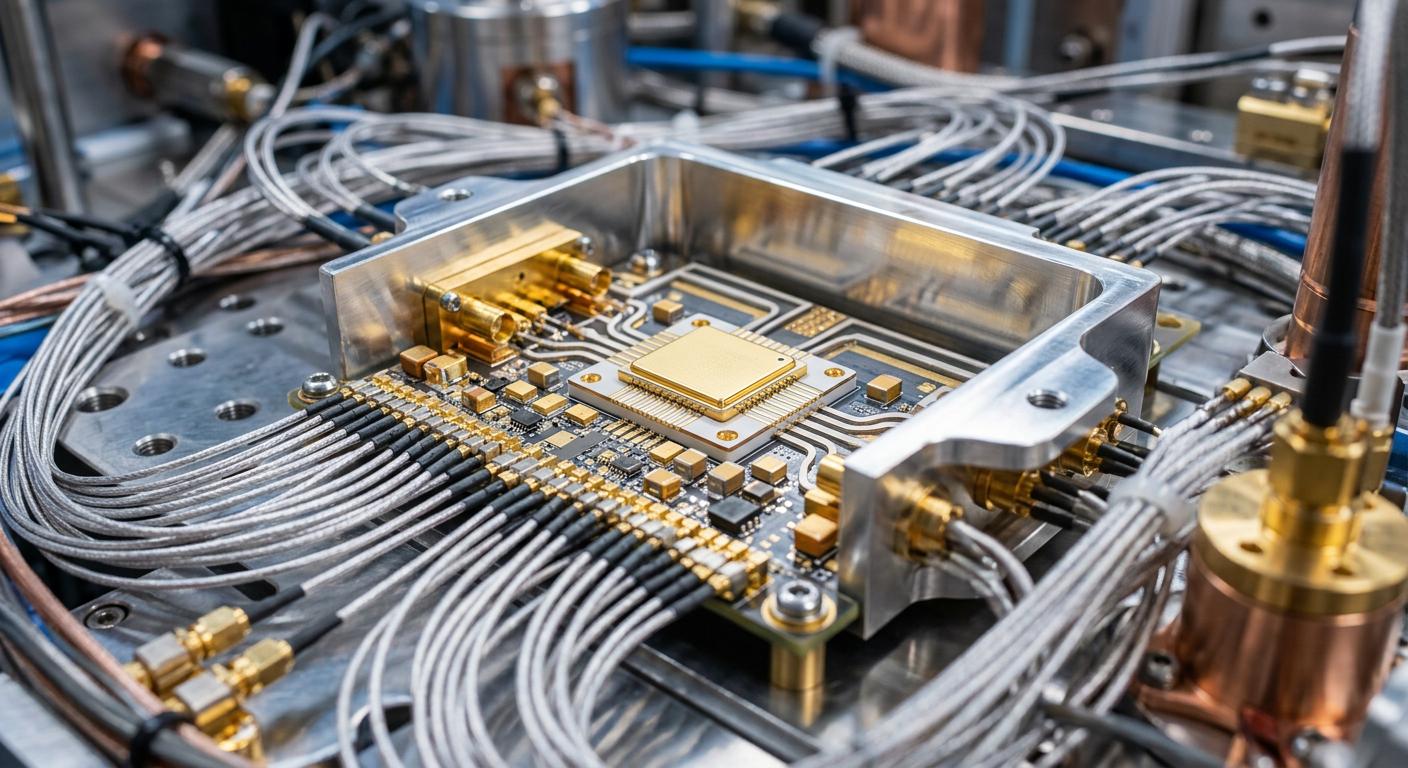
Image 4: Close-up view of a quantum processor used in quantum networking research.
Image 5: Smart city connected through highly secure quantum internet infrastructure.
Image 6: Digital illustration representing quantum encryption protecting sensitive online communications.
Image 7: Concept art showing the future of global quantum networking and secure data transmission.
The Quantum Internet Is Closer Than You Think: How Unbreakable Communication Could Change the Digital World Forever
For more than 50 years, the internet has transformed nearly every aspect of modern life. It has connected people across continents, enabled instant access to information, powered global commerce, and created entirely new industries. Yet despite these remarkable achievements, today’s internet still relies on communication technologies that face growing challenges from cyberattacks, data breaches, and increasingly powerful computers.
Now, scientists around the world are working on an ambitious next step: the Quantum Internet. Unlike today’s internet, which transmits information using classical bits represented as 0s and 1s, a quantum internet would use the principles of quantum mechanics to exchange information in fundamentally different ways.
Although the technology is still in the research and early testing stage, experts believe quantum networking could eventually enable ultra-secure communication, new forms of distributed computing, and scientific breakthroughs that are impossible with conventional internet infrastructure.
What Is the Quantum Internet?
The quantum internet is a proposed communication network that uses quantum states instead of only traditional digital signals to exchange information.
Rather than replacing today’s internet overnight, a quantum network would likely operate alongside existing internet infrastructure.
Its primary goal is to enable communication that takes advantage of quantum properties such as:
- Quantum entanglement
- Quantum superposition
- Quantum key distribution
- Quantum state transfer
These technologies could make certain types of communication far more secure than conventional methods.
How Does It Work?
Unlike traditional internet data, which travels as electrical or optical signals carrying digital bits, quantum communication relies on quantum bits, commonly called qubits.
Qubits can exist in multiple quantum states under specific conditions, allowing entirely new methods of transmitting and protecting information.
One important concept is quantum entanglement, where two particles become linked so that measurements of one are correlated with the other, even when separated by large distances.
Researchers are exploring ways to use these quantum properties to create secure communication channels across future quantum networks.
Why Is Security Such a Big Advantage?
One of the biggest motivations for developing a quantum internet is cybersecurity.
Current encryption methods rely on mathematical problems that are extremely difficult for conventional computers to solve.
Future quantum computers, however, may eventually solve some of these problems much faster than today’s machines.
Quantum communication offers a different approach.
With Quantum Key Distribution (QKD):
- Encryption keys are exchanged using quantum particles.
- Attempts to intercept the transmission disturb the quantum state.
- Legitimate users can detect possible interception attempts.
This characteristic makes quantum communication especially attractive for protecting highly sensitive information.
Potential Applications
Although widespread deployment is still years away, researchers see numerous possible applications.
Government Communications
Highly secure diplomatic and defense communications.
Financial Services
Protection of banking transactions and financial data.
Healthcare
Secure transmission of sensitive medical records.
Scientific Research
Connecting quantum computers to solve complex scientific problems collaboratively.
Critical Infrastructure
Protecting power grids, communication systems, and transportation networks.
Quantum Internet and Quantum Computing
Quantum computing and the quantum internet are closely related but serve different purposes.
- Quantum computers perform complex calculations using qubits.
- Quantum networks connect quantum devices securely.
Future quantum networks may allow multiple quantum computers located in different regions to work together, forming a distributed quantum computing system.
This concept could dramatically increase computational capabilities for certain specialized applications.
Current Progress Around the World
Research institutions, universities, and technology companies are actively developing quantum networking technologies.
Current achievements include:
- Experimental quantum communication over fiber-optic cables
- Satellite-based quantum communication demonstrations
- Improved quantum memory systems
- Development of quantum repeaters
- Expansion of quantum research networks
While these systems remain experimental, steady progress continues each year.
Technical Challenges
Building a global quantum internet remains a major scientific challenge.
Signal Loss
Quantum information can degrade over long distances.
Quantum Repeaters
Researchers are developing specialized devices to extend communication ranges.
Hardware Complexity
Quantum devices often require highly controlled operating environments.
Scalability
Connecting large numbers of quantum devices reliably remains an ongoing engineering challenge.
Scientists continue making progress toward overcoming these obstacles.
Could It Replace Today’s Internet?
Probably not.
Most experts believe the quantum internet will complement, rather than replace, today’s internet.
Traditional internet infrastructure will remain highly effective for everyday tasks such as:
- Streaming video
- Social media
- Web browsing
- Online shopping
Quantum networking is expected to focus on specialized applications requiring extremely high levels of security or quantum computing capabilities.
The Future of Quantum Networking
Industry experts expect continued progress throughout the coming decade.
Future milestones may include:
- Larger quantum communication networks
- Improved quantum repeaters
- Expanded satellite-based quantum links
- Commercial quantum security services
- International quantum networking standards
- Integration with existing internet infrastructure
As technology matures, quantum networking could gradually expand into new industries.
Why the Quantum Internet Matters
The quantum internet represents a new way of thinking about communication.
Instead of relying solely on increasingly complex encryption algorithms, it explores communication methods rooted in the fundamental laws of physics.
Although widespread deployment remains years away, the research underway today could eventually reshape cybersecurity, scientific collaboration, cloud computing, and global communications.
Like the early internet decades ago, today’s experimental quantum networks may become the foundation for tomorrow’s digital infrastructure.
Final Thoughts
The quantum internet is one of the most ambitious technology projects currently under development. By harnessing the unique properties of quantum mechanics, researchers hope to build communication networks capable of unprecedented levels of security and entirely new forms of computing collaboration.
Significant engineering challenges remain, and large-scale commercial deployment is still some years away. However, advances in quantum communication, quantum processors, and networking technologies continue to move the field forward.
While it is unlikely to replace today’s internet for everyday online activities, the quantum internet could become an essential layer for protecting critical infrastructure, enabling scientific discovery, and supporting the next generation of secure digital communication. As research accelerates worldwide, this once-theoretical concept is steadily moving closer to reality.
Leave a Reply