

7
Image Alt Text
Image 1: LED lighting system transmitting wireless internet using Li-Fi technology.
Image 2: Modern office equipped with Li-Fi wireless communication for high-speed connectivity.
Image 3: Researchers testing optical wireless communication systems in an advanced laboratory.
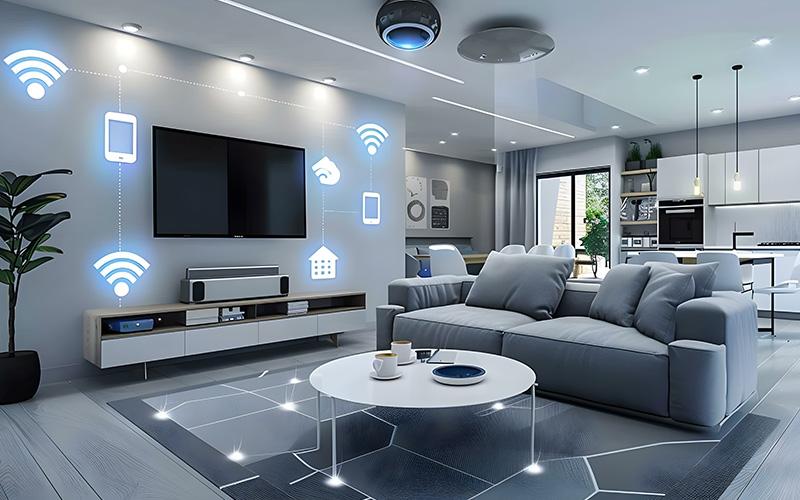
Image 4: Smart home using Li-Fi technology for secure high-speed internet access.
Image 5: Digital illustration showing data transmission through LED light signals.
Image 6: Smart city infrastructure integrating Li-Fi wireless communication networks.
Image 7: Close-up of an energy-efficient LED light supporting optical wireless data transmission.
Beyond Wi-Fi: How Li-Fi Technology Could Deliver Faster, More Secure Internet Through Light
Wireless internet has become an essential part of everyday life, connecting billions of devices across homes, offices, schools, hospitals, airports, and public spaces. For more than two decades, Wi-Fi has dominated wireless networking, allowing smartphones, laptops, televisions, and smart home devices to communicate through radio waves. However, as the number of connected devices continues to grow and demand for faster speeds increases, researchers are exploring new technologies that could complement—or in some situations even outperform—traditional Wi-Fi.
One of the most promising innovations is Li-Fi, short for Light Fidelity. Instead of transmitting information through radio frequencies, Li-Fi uses rapidly modulated LED light to send data wirelessly. Because these light changes occur millions of times per second—far faster than the human eye can detect—users experience ordinary illumination while devices receive digital information.
Although Li-Fi is still emerging, advances in LED lighting, optical communication, and semiconductor technology are moving it closer to practical deployment. Many experts believe Li-Fi could become an important component of future wireless networks, especially in environments where speed, security, and reduced radio interference are priorities.
What Is Li-Fi?
Li-Fi is a wireless communication technology that transfers digital information using visible light.
Instead of relying on radio signals like Wi-Fi, Li-Fi uses LED bulbs that rapidly change their light intensity to encode data.
A typical Li-Fi system includes:
- LED light source
- Optical transmitter
- Light-sensitive receiver
- Signal processing hardware
- Network controller
These components work together to create a wireless communication system using light instead of radio waves.
How Li-Fi Works
Li-Fi operates by rapidly switching LED lights on and off.
Although the flashing occurs millions of times every second, it is invisible to the human eye.
The process works as follows:
- Internet data reaches the LED transmitter.
- The LED converts digital information into rapid light pulses.
- A photodetector receives the light signals.
- Electronic circuitry converts the signals back into digital data.
Because the modulation occurs at extremely high speeds, Li-Fi can support fast wireless communication while simultaneously providing room lighting.
Why Researchers Are Interested in Li-Fi
Wireless networks continue becoming more crowded as billions of devices compete for radio spectrum.
Li-Fi offers several potential advantages:
- Extremely high bandwidth
- Reduced radio interference
- Improved security
- Low latency
- Energy efficiency
- Dense device support
Visible light represents a vast portion of the electromagnetic spectrum, offering significantly more available bandwidth than the radio frequencies currently used for Wi-Fi.
Potential Speed Advantages
One of Li-Fi’s biggest attractions is speed.
Laboratory demonstrations have achieved extremely high data transmission rates under controlled conditions.
Commercial systems currently provide lower—but still impressive—performance suitable for many business and industrial applications.
Future improvements in LED technology and optical networking could further increase practical speeds.
Enhanced Security
Because light cannot pass through solid walls, Li-Fi naturally limits signal leakage.
This provides several security benefits:
- Reduced interception risk
- More localized network coverage
- Better protection for sensitive environments
Organizations handling confidential information—including hospitals, research laboratories, and financial institutions—may benefit from these characteristics.
However, like all communication technologies, Li-Fi still requires robust cybersecurity practices.
Applications in Smart Homes
Smart homes continue adding connected devices including:
- Security cameras
- Smart speakers
- Thermostats
- Appliances
- Lighting systems
- Entertainment devices
Li-Fi could allow LED lighting fixtures to provide both illumination and wireless connectivity simultaneously.
This integration may improve network capacity while reducing congestion on traditional Wi-Fi networks.
Healthcare Opportunities
Hospitals contain sensitive medical equipment that may require careful management of radio-frequency interference.
Li-Fi offers a communication method that does not rely on radio waves.
Potential healthcare applications include:
- Patient monitoring
- Medical imaging systems
- Hospital data networks
- Connected medical devices
- Laboratory communication
Researchers continue studying where optical communication can complement existing hospital networking infrastructure.
Industrial and Manufacturing Uses
Factories increasingly rely on automation and Industrial Internet of Things (IIoT) devices.
Li-Fi could support:
- Robotic systems
- Automated production lines
- Warehouse management
- Industrial sensors
- Machine monitoring
Because many industrial facilities already use extensive LED lighting, integrating communication capabilities into lighting infrastructure could become more practical.
Smart Cities and Transportation
Urban planners are exploring Li-Fi for future smart city projects.
Possible applications include:
- Intelligent traffic lights
- Connected street lighting
- Public transportation
- Airport terminals
- Railway stations
- Vehicle-to-infrastructure communication
LED streetlights may eventually transmit localized information to nearby connected devices.
Challenges Facing Li-Fi
Despite its promise, Li-Fi also has limitations.
Line-of-Sight Requirements
The receiver generally needs access to the light signal.
Limited Coverage
Each light source covers a relatively small area.
Lighting Dependency
Communication depends on functioning LED illumination.
Infrastructure Costs
Existing buildings may require upgrades to support Li-Fi hardware.
Researchers continue improving system designs to overcome these challenges.
Li-Fi vs Wi-Fi
Rather than replacing Wi-Fi entirely, Li-Fi is expected to complement existing wireless technologies.
| Feature | Wi-Fi | Li-Fi |
|---|---|---|
| Signal Type | Radio Waves | Visible Light |
| Penetrates Walls | Yes | No |
| Security | Good | Potentially Higher in Local Areas |
| Radio Interference | Possible | None |
| Typical Coverage | Larger Areas | Single Light Zone |
| Best Applications | General Networking | High-Density, Secure Environments |
Future wireless systems may combine both technologies for optimal performance.
The Future of Optical Wireless Networking
Experts believe Li-Fi will continue evolving alongside Wi-Fi, 5G, and future 6G networks.
Future developments may include:
- Faster LED communication
- Integrated smart lighting
- AI-managed wireless networks
- Smart factories
- Connected classrooms
- High-speed aircraft communication
- Secure government facilities
As optical communication technologies mature, Li-Fi may become an increasingly valuable part of next-generation networking.
Final Thoughts
Li-Fi represents one of the most exciting developments in wireless communication. By using ordinary LED lighting to transmit digital information, it offers an innovative alternative to traditional radio-based networking.
Although technical and infrastructure challenges remain, continued advances in LED technology, optical engineering, and semiconductor design are bringing Li-Fi closer to practical deployment. Rather than replacing Wi-Fi, Li-Fi is likely to become an additional layer of connectivity, particularly in environments where security, speed, and reduced radio interference are important.
As the demand for faster and more reliable wireless communication continues to grow, Li-Fi demonstrates how everyday lighting could play an unexpected role in shaping the future of the internet.