🔥 Industry 5.0 Explained: How Smart Factories Are Transforming Manufacturing
The Smart Factory Revolution: How Industry 5.0 Is Bringing Humans and AI Together to Build the Future


Image Alt Text
Image 1: A modern smart factory where workers collaborate with AI-powered robotic systems.
Image 2: Industrial robotic arm assembling products on an advanced manufacturing line.
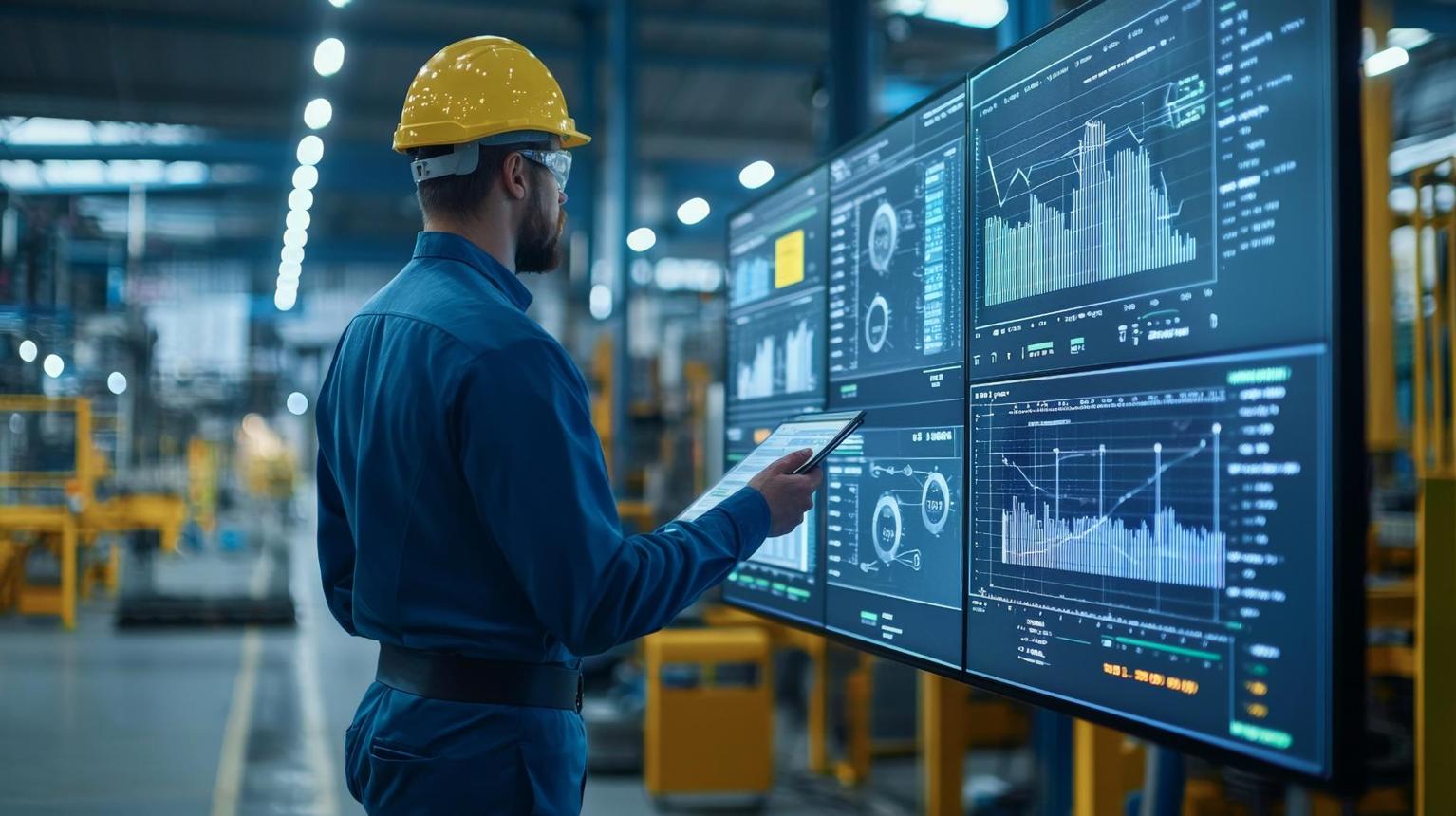
Image 3: Engineer monitoring factory performance through a real-time digital analytics dashboard.
Image 4: Industrial IoT sensors collecting production data inside a connected manufacturing facility.
Image 5: Autonomous mobile robots transporting materials through a smart warehouse.
Image 6: Factory technician working safely alongside a collaborative robot on the production floor.
Image 7: Futuristic concept illustration of Industry 5.0 combining humans, AI, and advanced automation.
The Smart Factory Revolution: How Industry 5.0 Is Bringing Humans and AI Together to Build the Future
Manufacturing has always evolved alongside technological innovation. From the steam-powered machines of the Industrial Revolution to the assembly lines of the 20th century and the automation systems of Industry 4.0, each transformation has reshaped how products are designed, manufactured, and delivered.
Today, a new phase is emerging: Industry 5.0. Rather than focusing only on automation and efficiency, Industry 5.0 emphasizes collaboration between humans and intelligent machines. Powered by artificial intelligence (AI), collaborative robots, industrial Internet of Things (IoT) devices, cloud computing, and advanced analytics, this new approach aims to create factories that are not only more productive but also more flexible, sustainable, and human-centered.
Around the world, manufacturers are investing in smart factory technologies to improve quality, reduce waste, strengthen supply chains, and respond more quickly to changing customer demands. While fully autonomous factories remain rare, the principles of Industry 5.0 are already influencing how many organizations approach modern manufacturing.
What Is Industry 5.0?
Industry 5.0 is an evolution of Industry 4.0. While Industry 4.0 introduced connected machines, sensors, and automation, Industry 5.0 places greater emphasis on human creativity working alongside intelligent technologies.
Instead of replacing workers, Industry 5.0 seeks to enhance their capabilities through:
- Artificial intelligence
- Collaborative robots (cobots)
- Real-time analytics
- Digital twins
- Advanced sensors
- Industrial IoT
- Edge computing
- Machine learning
The goal is to combine the precision and endurance of machines with the creativity, judgment, and adaptability of people.
How Smart Factories Work
A smart factory connects machines, production equipment, sensors, and software into a unified digital ecosystem.
Throughout the manufacturing process, sensors continuously collect information such as:
- Equipment temperature
- Machine vibration
- Production speed
- Energy consumption
- Product quality
- Inventory levels
This information is transmitted to AI-powered systems that analyze performance, identify trends, detect abnormalities, and recommend improvements.
Managers can monitor factory operations in real time through digital dashboards while AI assists with forecasting and production planning.
Collaborative Robots Are Changing Manufacturing
Unlike traditional industrial robots that often operate inside protective cages, collaborative robots—or cobots—are designed to work safely alongside people.
Cobots can assist with tasks such as:
- Assembly
- Packaging
- Material handling
- Quality inspection
- Machine loading
- Precision positioning
Workers continue performing tasks that require creativity, complex decision-making, and problem-solving, while robots handle repetitive or physically demanding work.
This partnership helps improve productivity while reducing workplace fatigue and injury risks.
Artificial Intelligence Improves Decision-Making
AI plays a central role in Industry 5.0 by analyzing vast amounts of operational data.
Machine learning systems can:
- Predict equipment failures
- Optimize production schedules
- Improve inventory management
- Detect manufacturing defects
- Forecast customer demand
- Recommend maintenance activities
Rather than reacting to problems after they occur, manufacturers increasingly use predictive analytics to anticipate issues before they disrupt production.
The Internet of Things Connects Everything
Industrial IoT devices form the digital backbone of modern smart factories.
Connected sensors monitor nearly every aspect of manufacturing operations, enabling real-time visibility across production facilities.
Examples include:
- Conveyor systems
- Robotic arms
- CNC machines
- Warehouse equipment
- Environmental monitoring systems
- Automated storage systems
Continuous data collection allows manufacturers to make faster and more informed decisions.
Customization Without Sacrificing Efficiency
Consumers increasingly expect products tailored to their individual preferences.
Industry 5.0 supports greater customization by allowing production lines to adapt quickly without requiring lengthy shutdowns or expensive reconfiguration.
Manufacturers can produce smaller batches while maintaining high levels of efficiency through AI-assisted scheduling and flexible automation systems.
This capability benefits industries ranging from automotive manufacturing to consumer electronics and medical devices.
Building More Sustainable Factories
Sustainability has become a major priority for manufacturers worldwide.
Smart factory technologies contribute by helping organizations:
- Reduce energy consumption
- Minimize material waste
- Optimize transportation
- Extend equipment life
- Improve recycling processes
- Monitor environmental performance
AI-powered optimization enables companies to identify opportunities for reducing resource usage while maintaining production quality.
Strengthening Supply Chains
Recent global disruptions highlighted the importance of resilient supply chains.
Industry 5.0 technologies improve visibility by tracking inventory, shipments, supplier performance, and production capacity in real time.
AI systems help organizations anticipate shortages, adjust production schedules, and identify alternative sourcing strategies more quickly.
This increased flexibility allows manufacturers to respond more effectively to changing market conditions.
Challenges to Adoption
Although Industry 5.0 offers significant advantages, implementation presents several challenges.
Investment Costs
Upgrading factories requires investments in sensors, robotics, networking, software, and employee training.
Workforce Development
Employees need new digital skills to work effectively alongside advanced technologies.
Cybersecurity
Connected factories generate valuable operational data that must be protected against cyber threats.
System Integration
Many manufacturers continue operating legacy equipment that must be integrated with modern digital platforms.
Addressing these challenges requires careful planning and long-term investment.
The Future of Industry 5.0
Experts believe smart factories will continue becoming more intelligent during the next decade.
Future developments may include:
- More advanced collaborative robots
- AI-powered autonomous production planning
- Expanded digital twin simulations
- Greater use of edge computing
- Predictive quality control
- Enhanced human-machine interfaces
- Smarter energy management
Rather than eliminating human workers, future factories are expected to rely increasingly on collaboration between people and intelligent machines.
Final Thoughts
Industry 5.0 represents a significant shift in how manufacturing organizations view technology. Instead of pursuing automation for its own sake, the focus is moving toward creating smarter, safer, and more sustainable workplaces where humans and AI collaborate effectively.
Through the integration of artificial intelligence, collaborative robots, industrial IoT, and advanced analytics, smart factories are becoming more adaptable to changing customer demands while improving productivity and reducing environmental impact.
Although many challenges remain, ongoing advances in digital technologies suggest that Industry 5.0 will play a major role in shaping the future of global manufacturing. As businesses continue embracing intelligent automation, the factory of tomorrow will not simply be more automated—it will be more connected, more efficient, and more human-centered than ever before.